Lost All Your Keys — How We Replace Them Without a Spare
Replacing a key with no existing key to copy from is a different
process. Instead of duplicating the cut from a working key, we use
the vehicle's VIN — the 17-character identification number on the
dashboard near the windshield base or on the driver's door jamb
sticker — to look up the original key code for your vehicle and cut
accordingly.
Before we do any of this, we verify ownership. The standard
documentation is a government-issued photo ID matching the name on
the vehicle registration or title. If you're a lessee, the lease
agreement works. If your registration is locked inside the car, the
VIN is visible through the windshield from outside — we can see it
without needing to access the vehicle first — and insurance cards
typically include the VIN as well. We need something that ties your
identity to that specific vehicle before cutting a key, every time,
without exception.
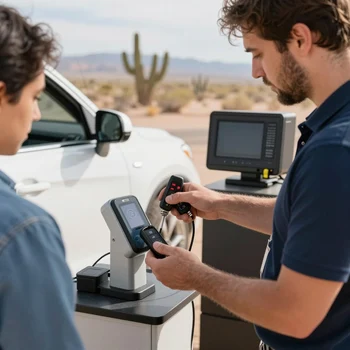
Once the key is cut and the chip is programmed, we test it: unlock
the door, start the engine, verify the remote functions if
applicable. You watch it work before we leave. The full process from
technician arrival to you driving away typically runs 30 to 45
minutes depending on the vehicle type and key complexity.
Vehicles We Cut and Program Keys For
Our key cutting and programming capabilities cover the majority of
vehicles on Phoenix roads. Domestic brands including Ford,
Chevrolet, GMC, RAM, Dodge, Jeep, Chrysler, Buick, Lincoln, and
Cadillac are in our standard range for both standard keys and the
various chip and proximity key types those brands have used across
model years.
Japanese and Korean imports — Toyota, Honda, Nissan, Mazda, Subaru,
Mitsubishi, Lexus, Acura, Infiniti, Hyundai, Kia, and Genesis —
cover a large share of the Phoenix vehicle population and are well
within our capabilities. European brands including Volkswagen, Audi,
Volvo, and Mini are standard. BMW and Mercedes-Benz are handled on
most models, with a subset of newer high-security configurations
that require dealer equipment. We'll ask for your year and specific
model when you call if there's any question about compatibility.
Older vehicles — cars and trucks from the 1980s and early 1990s that
predate transponder systems — are mechanically simpler from a key
cutting standpoint. No programming is required, just an accurate
cut. Classic vehicles and collectibles from the same era are handled
the same way.
Mobile Key Replacement vs. Going to the Dealer
The dealer is the familiar option and it works — but the practical
experience is significantly worse than most people anticipate when
they first call. If your only key is lost and the car isn't
drivable, step one is arranging a tow to the dealership. Step two is
waiting for a service appointment, which at most Phoenix-area
dealerships during busy periods means several days out. Step three
is the actual key replacement, which involves the same cutting and
programming process we perform, just done at the dealership's
location on their timeline.
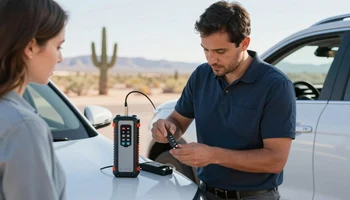
A mobile locksmith eliminates the tow and the wait. We come to where
the car already is, do the work there, and leave you with a working
key the same day you call. The equipment used for programming is the
same category of tool used at dealerships — the difference is that
it travels in a service van instead of sitting in a service bay.
There are vehicles for which the dealer is genuinely the only option
— primarily newer high-security European models where the
manufacturer has locked the programming to proprietary systems. For
those, we'll tell you straightaway rather than dispatch and waste
your time. But for the significant majority of vehicles driven in
Phoenix, a mobile locksmith is the faster, more practical solution.
If your vehicle is locked out as well, see our
car lockout service
— we handle both on the same call when needed.